Research

Research and survey information

Food Security and Supply Chain Risks - SPECIAL PROJECT


Business Continuity Forum - Securing the Food Supply Chain The Continuity Forum is part of a government working group researching short to medium term emergency issues relating to risk and the UK's food supply and its security. We are inviting interested parties to contact us to assist in the development of our formal report to the committees involved. We are particularly keen to gather information from Business Continuity, Resilience and Risk Professionals active in sectors relevant to the topic on the wider scope of issues being addressed.


The broad principles of the project are to identify how risks and disruptions may develop and how well the country is currently prepared to cope if they occurred.


Business Continuity Global Salary Survey

 
Global Salary Survey 
 
Welcome to our Salary Survey page over the past 8 years the Continuity Forum has
Business Continuity Global Salary Survey been measuring the pay and compensation of Business Continuity professionals working in the field and we are now launching our 2011 Global Survey.
 
Are you being paid what you are worth? Help us find out by completing the 2011 BCM Global Salary Survey 
 
All responses are of course completely confidentially and can be made anonymously if you wish and the Survey results are made available to all participants at no charge. 
 

Extreme Weather and Technology failure top the BCM event list


This years CMI Business Continuity Survey is available for download below and this year shows just how challenging 2011 was for organisations.
 
Overall the report details some interesting changes and reflects on the effects of the more social disruption and its effects than previous years surveys. 
 
Heading the list of incidents again was the winter weather That stuck hard nearly 30% of respondents  causing major disruption and impact of the snow and cold weather affected an additional 52% of the sample who report minor impacts on operations (82% total). This is the second year in a row that weather has been more problematic than IT issues that still hit 39% of organisations over the year up 5% on the previous survey.
 

ICM shares data on the causes of BCM plan invocation

ICM Business Continuity has released figures showing the causes of customer invocations from January through to June 2011. 
 
Out of 58 events 42 where related to hardware with 15 attributed to other causes including seven down to power issues and two instances each of Flooding, Fire and Data Corruption. There was even one denial of Access event.
 

*** Survey on BS25999 Usage ***

business continuity

This Business Continuity Survey is now closed.

The summary report will be issued in the 1st Qtr of 2011. If you would like more information please contact us directly.

Survey on BS25999 Usage

Some working in the field of Business Continuity may not remember a time before standards, but for many of us in the field for longer, the work of the BCM Committee of the BSI to create the world's first BCM standard was instrumental in developing much-needed consistency and credibility across the sector. The outcome of this work, BS25999, has been at the heart of much of the subsequent development in the discipline, and the BSI has one of the most successful Management Standards ever issued.

As BS25999 approaches its fourth birthday, the BSI BCM/1 committee, is looking to assess the experience and opinions of hundreds of practitioners and BCM managers all around the world on how they are applying BS25999 and its family of related standards and Published Documents in their organisations.

Consequently, the BCM/1 committee has developed the BS25999 2010 Survey, in conjunction with the Business Continuity Institute and the Continuity Forum, which they hope you will find the time to contribute to.

What does the UK Spending Review mean to you! - Survey

With the biggest review of UK PLC public finances for decades and cutbacks predicted across the whole of the Sector, we ask what does this mean for those working in governments  Business Continuity and Emergency Planning areas?

The Continuity Forum is asking those with frontline responsibility for Emergency Planning and Business Continuity what they think the future holds?

Continuity Forum UK Public Sector Spending Review Survey


Click on the link above to contribute your thoughts and views on the impact of the changes.

All contributions are confidential and the report of findings will be available for download in the next few weeks.

We also have a number of other Research studies underway that can be accessed by clicking Research on the Headline Tab above.


BS25999 under the microscope

The BSI, BCI and Continuity Forum are coming together to undertake an industry-wide survey on how the worlds most successful Business Continuity Standard, BS25999, is being used by organisations around the world.

Chris Green, Chairman of the BSI BCM/1 Committee that is responsible for the standard, comments “This survey will really help guide our thoughts on how the profession has responded to BS25999, and what we should be considering in the future.”

Continuity Forum Chairman, Russell Price said "BS25999 has been remarkably successful and is well established in the field ... but as the BCM sector evolves and experience grows we should regularly review the fit between standards and organisational needs."

BS25999 survey can be accessed by clicking the link below:

BS25999 Survey Link


All contributions are made in confidence and a report on the findings will be available on completion of the project.


A mixed report card for European BCM planning - Marsh 2010 EMEA research

Business Continuity Forum research news

Marsh publish new 2010 research on European wide BCM attitudes and opinion.


Two years ago Marsh published its first in-house survey into Business Continuity attitudes, this year's update gives us considerable food for thought in how the industry is developing and where priorities should lie. 


Encouragingly many of the underlying attitudes to business continuity appear to be positive, although there is clear evidence of different countries and industries progressing at markedly different rates. In the most established markets BCM has clearly become a core topic generally aligning well with the goals and objectives of the organisation. Integration across the business has also been seen to improve.

CMI report charts an interesting year for the BCM profession

Disruption and resilience, 2010 from the CMI


Over the course of the past 10 years the annual Business Continuity study by the Chartered Management institute has plotted the progress and expansion of the profession. 2010 is no exception.  Over the past 12 months the country has faced widespread disruption through extreme weather events, recession and the potential posed by the swine flu pandemic ... it has been a year to challenge most working in the field.


Marsh Finds UK Firms lacking Knowledge of Overseas Risks

Research by Marsh has determined that "British organizations are more concerned during the recession by overseas risks affecting their supply chains and business rather than by threats closer to home."

In its new Business Continuity Management (BCM) survey, "Facing an Uncertain Future," Marsh polled 109 UK firms and public sector organizations to establish their attitudes towards and levels of preparedness for key BCM risks such as terrorism, supply chain disruption and economic conditions.

Swine flu outbreak is reason to act, not panic - Gartner

Jun 8, 2009

Governments worldwide are preparing for the anticipated spread of AH1N1 influenza (swine flu), but enterprises should not overact to the outbreak. They should take this event as a wake-up call and review and test their pandemic response plans, according to Gartner, Inc.

“Business continuity management (BCM) and disaster recovery (DR) professionals and other stakeholders should use the widespread concern over the swine flu as an opportunity to prevent their enterprises from becoming victims of uncertainty, panic, misinformation and a lack of preparedness to increase enterprise awareness of the potential business impact of a widespread outbreak of disease,” said Richard De Lotto, principal research analyst at Gartner.

“Enterprises in all regions and across all industries should complete their review of their BCM/DR pandemic response plans and fill in any missing elements by the end of this week,” said Roberta Witty, research vice president at Gartner. “Starting today IT managers should meet with senior executives, line-of-business managers and other high-level decision-makers to answer any questions should be made aware of the seriousness of this pandemic preparation, to that will ensure a broad, ongoing commitment to this effort. IT managers should plan, test, and add capacity to ensure the sustainability of what is likely to be a predominantly work-at-home environment.”

Gartner analysts said a true pandemic could cause absenteeism rates of 40% or higher for enterprises and their business partners and suppliers, resulting in severe operational disruptions. For this reason, enterprises must recognise the urgent need to develop and implement pandemic response planning.
“In today's global business environment, IT professionals must recognise include extremely specific elements within their response plans that will overcome their enterprise's operational vulnerabilities which are not confined to the organisation's specific geographic locations,” said Ken McGee, vice president and Gartner fellow.

“These vulnerabilities also exist in the next town, adjacent states, neighbouring countries, or even on the other side of the planet, where their suppliers, customers, external professional service providers and so on are located.”
 

Enterprise BCM/DR professionals, security professionals, IT managers, line-of-business managers, and other stakeholders are encouraged to monitor www.pandemicflu.gov [7] and other government and public-health sources to determine what actions are appropriate to ensure workforce safety and continued
business operations. Gartner analysts said these key stakeholders should review audit pandemic response plans this week to assure they include:

•Identify existing and projected critical skills shortages
•Initiate necessary cross-training, testing or certification of personnel
•Ensure that cross-trained personnel have the appropriate system/applications access rights
•Determine which business operations are sustainable, and at what level, and
the likely downtime for normal business operations during periods with absenteeism rates of 40% or higher
•Immediately initiate rigorous, ongoing and well-documented testing to isolate and remediate identified problem areas.
•Prepare for travel restrictions to be significant in the event of an epidemic and near-universal in the event of a pandemic.
•Implement a communications program that ensures that all personnel are aware of the enterprise’s pandemic response plans, as well as measures they can take to limit the spread of the disease-including practices as simple yet effective as regular hand-washing.

Gartner has created a Special Coverage section on gartner.com “Planning for a Potential Pandemic” where comprehensive research related to pandemic planning can be found. Gartner analysts will provide regular updates regarding actions enterprises should take as the situation evolves.

The Special Coverage section can be found at http://www.gartner.com/it/products/research/coverage/pandemic09.jsp.  

Gartner analysts are also providing updates on the Gartner Business Continuity blog at http://blogs.gartner.com/business-continuity/ 

Formal Pandemic announced ... but how well are organisations prepared?

Swine Flu (H1N1) status change to Pandemic (Level 6)… amidst general business apathy.

11 June 2009

 
The World Health Organisation has increased the alert level for A(H1N1) or Swine Flu to a level 6 Pandemic alert.

This Pandemic Alert, the first for 40 years, confirms that the H1N1 virus is now maintaining sustained human to human infection in at least two geographic areas. With outbreaks as far apart as Australia and Europe, the upgrade to alert level 6 Pandemic is no surprise as the formal announcement is linked to a confirmation of wide geographic spread rather than any specific increase in the severity of infections.

Dr Keiji Fukuda, Assistant Director-General of the World Health Organisation speaking yesterday was at pains to stress that confirming Pandemic Status for this novel H1N1 virus “does not mean that the severity of the situation has increased and that people are getting more seriously sick at higher numbers or higher rates than they are right now”

He added, “We also do not know how this virus is going to evolve. It could become more mild over time, or it could become more severe over time, or it could stay pretty much as it is now. These are uncertainties that we have to take into account but we really do not know how that is going to go forward.”

In speaking on the infections to date that are now approaching 30,000 cases with many more suspected of going unreported, Dr Fukada indicated that most were in those below 60, with many infections occurring in those from in their mid 20’s. He stated that at the moment it was unclear whether or not this was due to the travel patterns or if there were other clinical factors involved. Of the 141 deaths seen so far half were in people with underlying health issues and the infection is currently generally assessed as “Mild and Self Limiting”, although it should be said that this could change as the virus develops.

What is clear though is that many people are likely to fall ill over the coming months and that this will have an impact, as they will be unable to work for between 7-10 days.

The Continuity Forum has been compiling data on the planning in place to cope with possible disruption caused by a pandemic over the course of the past month. Over 800 responses have been received from organisations of all types and their content reveals a stark difference in attitude between the public and private sectors.

Against a backdrop of rapidly rising cases (roughly doubling each week) the majority of businesses have still failed to heed government advice to plan for the effects of staff losses and other disruption. Amongst our very largest companies and in the Public Sector planning has generally been untaken, though there are doubts about the depth and likely effectiveness of measures taken and there is little evidence of real commitment to the process across the country.

Taking the top tier of organisations, fewer than half (46%) have implemented Pandemic specific plans with 78% of these being described as incomplete. Organisations with a significant international dimension fare only slightly better with 59% stating they have plans, although 67% are said to be incomplete.

Public Sector Organisations are generally better prepared in terms of planning, but outside of these sectors preparations and planning in organisations rapidly declines. Across the whole of the UK research suggests that fewer than 10% have any kind planning in place to help manage the impact of the Pandemic, which can reasonably be expected to continue to grow over the coming months and particularly in the traditional Flu season later in the year.

Hopefully the WHO announcement will motivate and stimulate many more organisations to start planning now.

Forum Comment

Commenting on the WHO announcement, Russell Price of the Continuity Forum stated “ The World Health Organisation are really just validating what has been evident for the past few weeks with the confirmation of this novel H1N1 virus as Pandemic. The issue isn’t what we are seeing at the moment but rather how it will develop, spread and evolve. Whilst 30,000 may appear to be a large number of cases, over the coming months this will continue to rise especially after the summer when the Northern Hemisphere enters its Flu season”

He added, “Caution and prudence are key in reacting to this threat, we should be careful to be neither complacent and underestimate or ignore the threat, or panic and over estimate it’s potential impact. There is a lot still to learn about the virus and there are issues around how it will develop … will it get more or less severe? We just don’t know at this time, and it must seen as prudent or indeed the responsibility of organisations to carefully consider how they may be affected later in the year. Failing to act now is throwing away the window of opportunity available to act and prepare for what could be said to be an inevitable period of disruption in the Autumn.”

The Continuity Forum is holding a Pandemic Summit on the 26th June that will provide a detailed update on the threat and the planning that can be undertaken by organisations.

In addition, there will be two Pandemic Planning workshops in July to further assist and support organisations develop their planning and response.

For more details on any of these sessions please contact us directly.


A(H1N1) initial research suggests parallels with 1957 Pandemic


Media criticise health organisations, but threat continues to develop 


As Swine Flu starts to slide down the news agenda, some are already declaring that the worst is over and it was an overreaction. Indeed nearly half of people in the US think the media exaggerated the threat, mirroring the view in the UK.

Is the really the case...is it over?

Well no and Business Continuity planners to need to heed the warnings coming from World Health Organisation and the US CDC as well as the Department of Health.

The A(H1N1) is still continuing its spread and Keiji Fukuda of WHO is stressing that they continue to be worried about what will happen as the southern hemisphere starts to enter Winter. Richard Besser of the CDC speaking on the 10th May warns that Mexico is still seeing significant transmission and there continues to be an upswing in infections in the US. Fukuda continues stating that “there is a good chance that the virus will re-emerge in the autumn and winter months in the northern hemisphere and that it could become more virulent.

Science Magazine is reporting the results of an initial study in the Mexico Swine Flu outbreak led by Professor Neil Ferguson of Imperial College, London confirming that the virus is a virulent as the 1957 pandemic, but not as bad as that seen in 1918. Estimates have calculated the more than 2,000,000 around the world in 1957.

The international teams provisional findings suggests that the case fatality rate for the A(H1N1) ranges between 0.3% and 1.5%, less dangerous than 1918, but still a substantial threat. The study also estimates that infection characteristics could change as the virus evolves and that we need to continue to develop information quickly to more fully understand its development.

Across the world and in little more than a month more than 5000 have been infected and 50 have died in this initial phase of the outbreak, certainly substantial enough to be case for considerable concern amongst informed experts and BCM planners should share this concern. It is far too soon to draw back from Pandemic planning or to be influenced media naysayers.

The Continuity Forum would stress the view from the Department of Health statement on Monday that “all infections in the UK so far had been "mild", but it is right to prepare for the possibility of a global pandemic. The UK's arrangements are continuing to ensure that we are well-placed to deal with this new infection."

This is especially important as Professor Ferguson states clearly that it is difficult to quantify the impact on human health at this stage. This is especially important when the statistics developed so far confirm that A(H1N1) is more infectious than usual; seasonal flu affects 1 in 10 and this novel virus potentially 1 in 3 and that per 1000 infected between 4 and 14 could die.

Against this background it is folly to start dismissing the risk, but we are already seeing signs of this with some BCM planners telling us that they are not getting the support from organisations to ensure the robustness of their plans. Perversely many report a wait and see approach being taken despite the guidance coming from WHO, CDC, HPA and a host of others to act now and ensure plans are in place.

The Continuity Forum is urging organisations to utilise Business Continuity expertise and knowledge to develop and assess plans that will support your business quickly; take the threat seriously and match your response.

Taking responsibility for your organisation and its personnel now and develop a better understanding of what you can do to mitigate the risks. Through active planning you can help reduce the spread of the illness across society and importantly your staff, limiting the financial and personnel impact on the organisation. You'll also be demonstrating prudent and professional management to clients and suppliers.

For more information on or assistance in planning please do get in touch. If you would like to comment on this feature please do contact us directly.

to find out more or attend our Special Summit on Pandemic Planning please follow the link from the front page.


We are changing our registration systems and if have yet to complete the new registration process please click on the link above.


For more details on our events, workshops and industry development work, as well as the general activities of the Continuity Forum please contact us directly on +44 208 993 1599 or mail us HERE!

Please do contact Sara McKenna or Russell Price .

 Creating Continuity ... Building Resilience ...

If you would like to know more about how your organisation can get involved and benefit from working with the Continuity Forum, please email us HERE! or call on + 44 (0) 208 993 1599.


A(H1N1) threat needs careful balance - Continuity Forum

Category Business Continuity Management research - BCM - BCM & Risk Management - General


 Continuity Forum urges organisations not to be complacent

5th May 2009

Swine Flu, or A(H1N1) as the World Health Organisation would prefer it called continues to dominate the news media internationally, with nearly 1100 cases in 21 countries now reported with 27 fatalities.

Good reaction, planning and Tamiflu intervention appears to be working and the symptoms are being described as Mild. This appears to be good news and in the last few days accusations are being levelled of the whole Pandemic scenario being hyped out of all proportion.

Radio phone-in's and media commentators articles are suggesting an over reaction by WHO, governments and the media in the face of what they describe as a relatively 'minor' Health scare. Despite information from the World Health Organisation and health agencies urging against complacency, many people are starting to trivialise the threat posed despite the warnings being given.
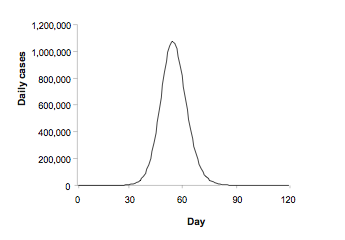
Pandemic transmission

Above is the predicted spread of an influenza Pandemic as developed by Professor Neil Ferguson and submitted to the House of Lords Science and Technology committee, which has responsibility for Pandemic Influenza.

As can be seen, the peak shows infections rising over time to over 1 million cases a day after about 7-8 weeks from the first UK infection. As with all modelling, it is an educated interpretation based on experience and analysis and Professor Ferguson's model may be incorrect or have errors that misrepresent the spread of infections (if it is, then so are many others that have been published), but look closely at the curve above.

We have had the A(H1N1) virus for just one week here in the UK; the government and HPA have done a sterling job, but one week in and the media are talking about the second phase potential. This is happening just four weeks BEFORE the research shows the rapid escalation of cases in the first phase model … we at the Continuity Forum think this is a little premature at least and potentially quite dangerous.

At the moment the instantaneous news media is giving immediate opinions on matters that need to be thoroughly understood. The epidemiology of A(H1N1) needs to be understood in much greater depth, and it is rash to dismiss this 'initial' stage of the current outbreak as over or under control just yet.

More needs to known about the source in Mexico and particularly the rate of fatalities that has not yet been seen elsewhere in the world. The death of 25 people from 590 cases suggest a Case Fatality Rate (CFR) of 4.24% which is much higher than Seasonal Flu and towards the upper levels of the worst case planning scenarios, yet in the US some 286 cases resulted in the death of one infant, a CFR of 0.35%.

Why is there such a huge difference?

Was it the source numbers underestimating the total number of cases in Mexico or was it something else?

Perhaps it is the early intervention with Anti-Virals given at the optimum time, stalling progression of the virus?

What ever the reason now is not the time to be suggesting the worst is over, and indirectly creating a sense of complacency in the minds of the general public and business.

The UK government is delivering advice to all homes urging vigilance and good hygiene protocols, trying to keep folks informed and aware of the potential risk of infection - and the simple steps required to mitigate them. This though is against a real mix of opinion in the general populace; some alert, informed and not unduly alarmed, but others dismissing it as Hype and overreaction!

Mexico will be returning to work tomorrow with shops, businesses, schools and restaurants all reopening. Hopefully the worst is past for them, but over the next few weeks we'll see what happens both in Mexico and the other countries as the Virus continues to develop.

Yes, we did say develop, as this is exactly what a virus does. It'll continue its evolution, changing and mutating, trying to find new ways to propagate itself. We are still at the the very earliest stages of this situation and our knowledge of it, and we should exercise caution in rushing to judgement.

>Careful consideration of the potential impact and sensible measures addressing them should be developed to help your organisation, and importantly be rehearsed and communicated. Of course, the naysayers could turn out to be right and the threat may fizzle out, but what incredible folly would it be to do nothing when the window of opportunity exists to really bolster resilience and create the potential for far better continuity.


The Continuity Forum can help and advise your organisation please mail us here Pandemic Support


Any organisation requiring advice or support should contact us immediately, we are also holding a Continuity Forum Special Pandemic Summit on June 26th for more details follow the front page link or contact us directly. More information on pandemic research


We are changing our registration systems and if have yet to complete the new registration process please click on the link above.


For more details on our events, workshops and industry development work, as well as the general activities of the Continuity Forum please contact us directly on +44 208 993 1599 or mail us HERE! Please do contact Sara McKenna or Russell Price .


Creating Continuity ... Building Resilience ...

If you would like to know more about how your organisation can get involved and benefit from working with the Continuity Forum, please email us HERE! or call on + 44 (0) 208 993 1599. 

Syndicate content

Business Continuity Forum creating Resilince and security

Creating Continuity... Building Resilience...